The Samurai has become one of the most infamous and popular parts of Japanese history. The reason for this is that they have often been known as the knights of Japan, elite warriors who were bound by ideals of honor and courage. It was between the 9th and 12th centuries that the Samurai ended up becoming a class of their own.
The wars that were present throughout Japan were over the fact that only 20% of the land was available for farming. With such a great need for warriors there arose two major warrior classes. The Samurai, who were considered knights and the bushi who were known as warriors. The samurai were a mixed group with some of them being part of the ruling class and some of them being hired men, completely loyal to their daimyo (feudal landowner).
As time passed the emperor allowed these elite warriors to become protection for all of districts and provinces. These positions became hereditary and the families became known for their skills as warriors. These warrior families perfected their skill and became to govern their lives around honing their skills as a warrior. They developed a strict system of codes known as Bushido. This code was at its core completely and utter devotion to the daimyo.
This devotion was so strong that part of the code that the samurai would kill himself if he ever failed in his duty to the daimyo. Any samurai who did fail in his duty and survived would become known as a ronin or masterless samurai. These ronin became beggars, assassins and they were completely shunned by society. Many of them would commit ritual suicide and some would threaten to commit suicide about the houses of wealthy lords as a way of embarrassing the lords into giving them food.
The life of a ronin was one that no proud and true samurai wished for and so suicide became a strict part of the code as well. Anytime a samurai failed in his duty or risked being caught in war, he would commit suicide in order to retain his some of his honor. These strict rules also applied to the females who lived in these warrior families.
The samurai were also known for being skilled both on foot and on a horse. They based their code, samurai dress and weapons on the ancient Yayoi warriors of China. These warriors wore a helmet to protect their head and neck, a breastplate, arm and shoulder protectors and a belly warp. Later this armor would include protection for the legs and thighs.
The samurai are still known today as some of the best and most honorable warriors Japan has ever known.
Wednesday, January 6, 2010


Sunday, January 3, 2010
History of Japanese Dolls
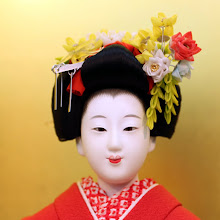
Japanese dolls have always been a very important part of Japanese culture due to the fact that they are often created as part of household shines and as a way to give and receive blessings. In Japanese these dolls are called Ningyo which literally translates to human shape. The most prominent time when dolls are created and displayed in modern Japan is during the Hinamatsuri or the Japanese Doll Festival.
The tradition of creating dolls is steeped in Japanese culture with the earliest known records around 3 BC but it is suggested that this tradition may go even further back. In 3 BC it was written in the records of the Ise Temple that grass dolls would be made and blessed before being thrown into the river close to the shine. This tradition still continues today in the form of the Hinamatsuri in which dolls are created, placed into small boats and sent out to sea. This tradition is done to send away bad spirits and bring forth new blessings.
The ancient Jomon culture in Japan which reigned from 8000 – 200 BC was known to create humanoid figures but it is unknown if these dolls had the same significance that they would later have for the Japanese people. In the Kofun culture which lasted from 300 -600 AD it was customary to create funeral figures but this practice is largely extinct today.
In the early eleventh century Japanese dolls began to take on the form that they are known to have today. During the peak of Heian period there were a number of different types of dolls including dolls for play and dolls for protection. They were also used in religious ceremonies in which they would take on the sins of any person they touched.
It was during the Edo period from around 1603-1867 that the practice of artesian dollmakers developed. These dollmakers would strive to create sets of dolls that would be displayed in the homes of the rich. This practice continues to this day during the Hinamatsuri festival it is traditional for people to display a Hina set in their home. A traditional hina set consists of 15 Japanese Dolls which can differ from household to household but a usual set is done in a male-female pattern, often referred to as the Emperor and Empress.
The Japanese doll tradition has existed for thousands of years and is perhaps one of the longest lasting and most historical Japanese traditions. After centuries of perfection these dolls are now truly intricate and beautiful dolls, that are unmatched by any other.
Wednesday, December 30, 2009
Japanese Doll Festival
Every year on March 3 in Japan a festival takes place called Hinamatsuri. This festival has many names including the doll festival and Girl’s Day. During this festival large tiered red platforms are created to display Japanese dolls. These dolls are referred to as hina-ningyo and are traditional ornamental dolls dressed in traditional clothing. Typically these dolls are created to represent the Emperor, the Empress, and their attendants and musicians. The placement of these dolls is often strictly adhered to.
The placement of the Japanese dolls is as follows: The top tier holds the Emperor and the Empress. The second tier holds three court ladies. The third tier is reserved for five musicians and the fourth tier contains two ministers. The bottom tier holds three servants. It is also typical for representations of household items such as small furniture and meals to be placed beside the Japanese dolls.
The festival actually draws its roots from the period in which it was tradition for Japanese dolls to be set afloat. This tradition was known as hina-nagashi and it entailed created straw hina dolls, putting them in boats and setting them afloat down the river and to the sea. This was supposed to carry away troubles and bad spirits. The practice of sending them down rivers has come out of practice as fishermen were often catching the dolls in their nets. Now the dolls are sent out to sea. Once the spectators have left the boats are collected and then brought back to the temple to be burned.
Today this day is meant as a way for families to wish their daughters happiness and a successful life. It is traditional for Japanese dolls to be displayed in the home along with peach blossoms and traditional sweet sake called amazake is served. This sake is non-alcoholic and made from fermented rice. There are also traditional forms of sushi and crackers that are meant to be eaten on this day.
There are even songs sung during the festival, one of which is Ureshii Hinamatsuri or Happy Hinamatsuri and the lyrics when translated to English are as follows:
Let's light the lanterns
Let's set peach flowers
Five court musicians are playing flutes and drums
Today is a joyful Dolls' Festival!
Friday, November 6, 2009
Masamune Date Word
"Stick too much to Justice, you become inflexible.
Too much compassion, you get weaker."
Too much compassion, you get weaker."
Thursday, November 5, 2009
"Jin-仁" Love and compassion
Someone can take over the country without Jin, but No one can become the ruler of the kingdom without Jin.
This is a word of Mencius.
So, Samurai must have Jin to rule people.
This is Samurai's duty to have Jin, otherwise, society can not be reserved many years cause if people don't feel their favor, another ruler should stand.
Samurai imposed themselves on having Jin as ruler.
This is so true in anywhere. If you become a manager, we try to have Jin.
Otherwise we never win the hearts and minds of the people.
Monday, November 2, 2009
"Yuu-勇" bravery
My favorite word - 義を見てせざるは勇なきなり
Translation is like
You are not brave if you don't do right thing, facing the necessity of right thing.
Sometimes people can not take right actions due to her/his circumstances.
However, they themselves know they are cowards.
So, Samurai was trained to overcome this cowardice because cowardice ends up losing the phlegm in an extreme situation.
It is the Samurai to control their fear in any circumstances and judge their actions in a calm manner.Genuine bravery can do this calm manner in really really extreme situations.
Interesting enough Samurai was trained not to be confused in any situations.
Totally different world from peaceful everyday.
Sunday, November 1, 2009
"Gi"
"Gi-義" is the most important virtue.
Simple explanation is "Do the right thing as human beings".
For Samurai, "Gi" is a kind of self-rule to judge their action.
If death is the right thing, Samurai dies.
If you have to fight against justice, Samurai never escapes and fights even they know they die.
Filthy behavior, foul actions,, these are totally against "Gi" way.
Looking at myself, it is sometimes quite difficult to fight back against evil just because we want to secure our daily lives.. Poor weak mind.
Be SAMURAI! Boy.
Subscribe to:
Posts (Atom)